
Syracuse is one of the most beautiful cities on the sea in the Mediterranean, His wealth of history and monuments makes it the expression of all the variety and cultural complexity of Sicily.
Geographically it appears as a large limestone terrace overlooking the below coastal line equipped with a magnificent natural port, The city is divided between an old part, Ortigia, and a more modern new part.
The old town, A fascinating islet, It preserves the magic of a land that has seen successful and stratified over the millennial important expressions of the most important civilizations of the Mediterranean.
Ortigia is the true soul of Syracuse, Visiting it is a pleasant journey between Greek temples and Christian churches, Swabian palaces, Aragonese and Baroque, courtyards, Arab alleys, shop, modest homes and large public buildings, All in a single square kilometer.
Il Duomo, Doric Temple built on Sicilian settlements transformed over time into the Byzantine basilica before, Norman Church then, late Renaissance and finally Baroque, The beautiful squares, the Source Aretusa, The Jewish neighborhood, The synagogue transformed into a Catholic church, the Regional gallery with works of Antonello da Messina e Caravaggio, l’Institute of the ancient drama and a singular Cinema Museum These are just some of the wonders of Ortigia. Surprising and magnificent walking through the animated streets that intersect with lone alleys on which there are ancient abandoned houses and then stop in the typical restaurants, coffee, Libraries and shops. For lovers of books and history a fascinating library that houses rare and ancient books and a precious numismatic collection.


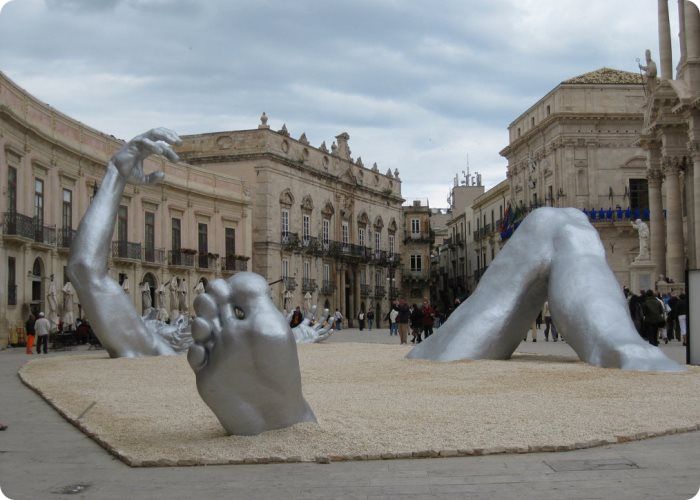


The eighteenth -century reconstruction after the earthquake of 1693 and the work of Vermexio, illustrious family of Syracusan architects, gave the place an 'baroque imprint very obvious.
Unable to summarize monumental wealth, beauty, The liveliness and melancholy of Ortigia. Whether it is discovered following precise itineraries or the instinct will be the sea the final meeting. The sea is the great, True charm of Ortigia, The natural port, fascinating at sunset, the market, smells, The fishing menus of the restaurants. Everything in Ortigia brings to the sea.
Left Ortigia and its history is found in the modern city which in its expansion has incorporated part of the archaeological heritage of the city such as the Latomie dei Cappuccini, the Church and the Catacombs of San Giovanni Evangelista, il Sanctuary of Demetra e No.
Il Neapolis park with the largest Greek theatre arrived up to us from antiquity, the Roman amphitheater, The Ara of Ierone II, The latomie of paradise and s. Venus, The cave cave and the ear of Dionisio, he knows how to give the suggestion of a place where nature, History and myth meet and intertwine wonderfully. The new and well -designed seat of the Paolo Orsi Regional Archaeological Museum It exhibits very important finds of Sicilian prehistory, of the Greek city, of its colonies and other Greek-western cities.
Same historical treasures can be found preserved at Papyrus Museum.
To visit absolutely the Roman gymnasium, il Cooks River, where the papyrus still grows, The remains of Temple of Zeus and the Euro Castle, Greek fortification built in 402 a.C. From Dionisio the Elder.
The Greek theater and its biennial cycle of Classic shows They are the best known expression of Syracusan cultural life which however tends to livenly in recent years. The shows, together with other cultural activities and the theater of the ancient world, I am organized by the I.N.D.A., National Institute of the ancient drama, based in Greek palace.
Siracusa maintains an intense religiosity in devotion to the Madonna and a S. Lucia, patron saint of the city, whose celebrations, il 13 December, record a large popular participation. The cult of the Madonna has undergone an intensification below an event considered miraculous: The tearing in the 1950s of a simulacrum of the Virgin. Since that time Syracuse has been one of the privileged places of the Marian worship and the great sanctuary recently built and dedicated to the Madonna delle Lacrime is the most evident testimony.